Showing posts with label ohio. Show all posts

May 05, 2026

EWING

Cleveland Auto Cab Co. (1908)
Ewing Automobile Co. (1909-1911)
Geneva, Ohio


This is a Ewing radiator script (c1909)   dkc
Size: 90mm wide 45mm high

The Ewing taxicab, designed by Louis P. Mooers and built by the Cleveland Auto Cab Company, was an attractive motor vehicle. Production began earlier in 1908 but the Ewing was introduced at the Ninth International Automobile Show at Central Palace, New York on New Year's Eve in December 1908. Levi Edward Ewing was a substantial investor in the Cleveland Auto Cab Company and by February 1909, he had taken over the company and renamed it the Ewing Automobile Company.  

The Ewing was available as a taxicab or as a town car both powered by a four-cylinder 24 hp engine. About thirty Ewing cars were built in 1908 and another forty-seven in 1909. 

Ewing found it difficult to recruit and maintain a workforce of skilled mechanics in the small town of Geneva and considered a move to Erie, Pennsylvania but in October 1909 he sold out to William C. Durant, who was building his General Motors empire. Durant closed the Ewing Automobile Company in June 1911. 

Emblem

The only original photo I have seen of a Ewing town car does not show a radiator emblem, see below:

Ewing town car (1909)      scac

It is noted that a Ewing nameplate, possibly a serial plate, is mounted on the outside of the dash firewall.

However, a brass Ewing radiator script does exist, see photo shown at the top of this post. It is believed that this Ewing radiator script is original and may be from a Ewing taxicab. Original Ewing radiator scripts and nameplates are very rare. 

If you have details of any other Ewing emblems or nameplates, please let me know, in order to update this post.


December 15, 2025

CLARK-NORWALK

Clark-Norwalk (1910-1911)
Cleveland, Ohio


This is a Clark-Norwalk radiator emblem (1910-1911)  sam
Size: 64mm high 64mm wide   MM: Unknown

The Clark related to this motor car was the name of a motor car sales agency in Cleveland, Ohio that sold the four-cylinder Norwalk motor car built in Norwalk, Ohio in 1910 to 1911 (see Norwalk).

However, the Clark-Norwalk was an entirely badge-engineered motor car. It was in fact the Norwalk motor car but with a Clark emblem. This business arrangement was short-lived, as the Norwalk business in Norwalk, Ohio was bankrupt by early 1911.

The Norwalk also offered similar badge-engineered services to other motor car manufacturing companies and continued to to do so after the Norwalk moved to Martinsburg, West Virginia in 1912.  

Emblems

The Standard Catalog of American Cars says the Clark-Norwalk carried a brass Clark script on the radiator core. I have not seen any original period photos or illustrations showing a Clark-Norwalk with a radiator script but this may have been correct at the start of this business arrangement in early 1910. 

The Clark-Norwalk is known to have been shown at the Cleveland Armory Automobile Show in late 1910. The following original period photo shows some Clark-Norwalk completed cars and chassis displayed at an automobile trade show referenced to be in 1911 but there is no sign of a Clark radiator script:

A group of Clark-Norwalk cars at a trade show (1911)    dpl

However, a closer look at the completed cars in the photo show a cross-shaped emblem mounted on the radiator core:

Close up showing Clark-Norwalk cars with emblems mounted on the radiator core

These cross-shaped Clark-Norwalk radiator core emblems are shining brightly due to reflection of the trade show lights on the light colored enamel finish of the emblem. 

This is the yellow enamel Clark-Norwalk radiator emblem shown above at the top of this post and again below. This Clark-Norwalk radiator emblem is extremely rare and possibly ultra rare.

This is a Clark-Norwalk radiator emblem (1910-1911)  sam
Size: 64mm high 64mm wide     MM: Unknown


November 04, 2025

WORLDMOBILE

Service-Relay Motors Corp. (1927-1928)
Lima, Ohio


This is a Worldmobile radiator emblem (c1928)  autopasion
Size: Unknown    MM: Unknown

Service-Relay Motors Corporation was building a range of Relay, Service, Commerce and Garford motor trucks but decided to produce an automobile called the Worldmobile. It was planned that the Worldmobile would be produced by a new company to be called the Worldwide Company but this did not happen.

The Worldmobile was a large six-passenger sedan car powered by a 65 hp eight-cylinder engine. A number of prototypes are reported to have been built and one still survives. The body styling of the Worldmobile was ordinary and very much out of date for its time. The Worldmobile was unlikely to have succeeded in any case, but the Service-Relay Corporation was itself going through changes in its ownership and management. In the event, the Worldmobile did not proceed into production. 

Emblem

The Standard Catalog of American Cars suggests that "the prettiest thing about the Worldmobile was its radiator badge". The metal Worldmobile radiator emblem shown above is ultra rare.


August 21, 2025

BECK

C. D. Beck & Co. (1934-1957)
Sidney, Ohio

This is a Beck bus emblem (c1938)     lktec
Size: 248mm wide 133mm high  MM: None

C. D. Beck organised a group of investors and bought the Anderson Body Company. Anderson built a range of buses from 12 to 33 passenger capacity, including a number of school buses, based on commercial chassis and using Airstream bodies, which carried the Beck name. By mid-1934, the Anderson name disappeared from company advertising.

Beck Airstream buses were updated and continued to be built on commercial chassis until 1939. New Beck bus models included the Fleetway passenger sedan and the COE Cosmopolitan bus in 1936 with the Metropolitan bus model appearing in 1937.   

Beck introduced new all-metal integral construction in 1938 for their Airstream and Steeliner models, although in appearance they looked the same as the previous body-on-chassis design. In 1939, Beck introduced the Super Steeliner, which was replaced in 1940 by the Mainliner and the Luxury Liner. Beck bus production stopped in 1942 due to wartime restrictions but special Commuter Express bus production began in 1943. 

A new factory was built in 1946 and regular bus production continued with new Mainliner models appearing in 1948. Beck acquired Ahrens-Fox in 1953 and relocated their fire engine manufacturing to Sidney, Ohio. Mack bought out Beck in 1956, essentially to acquire the Ahrens-Fox fire engine business. The Beck name disappeared in 1957.

Emblems

There are very few photos or illustrations of Beck buses clearly showing the emblem. However, the following photo of a 1938 Beck Super Steeliner shows an unusual shaped emblem above the radiator:

Beck Super Steeliner (1938)     curbsideclassic

This is the painted metal Beck emblem shown above at the top of this post. This Beck emblem is very rare.

The following original photo shows some Beck buses in Mexico probably in the early 1940's with a simple horizontal emblem with rounded ends:

Beck Steeliner Buses (c1940's)    curbsideclassic

Similarly shaped emblems were used on the front of some other Beck bus models, see example shown below:

Beck Model B-29 Transcontinental bus (1950)    transpressnz

The following is an example of one of the last Beck buses showing the Beck name displayed on the front of the bus:

Beck Bus showing front emblem (1956)    curbsideclassic

Close up showing the Beck name 


July 22, 2025

COLLIER

Collier Motor Truck Co.
Painesville, Ohio (1916-1917)
Sandusky, Ohio (1917)
Bellevue, Ohio (1918-1922)


This is a Collier heavy duty truck radiator emblem (1920)  hatm

The Collier truck was designed by William H. Collier, who had previously designed the Marathon motor car. The Collier Motor Truck Company was established in 1916 with a sales office in Cleveland, Ohio but the manufacturing plant was initially located in Painesville, Ohio. 

Most American truck references report that the first Collier trucks were 1/2-ton capacity units based on a standard passenger car design, although a Collier 3/4-ton Light Delivery truck advertisement in 1917 says "It is ALL Truck" and "It is not a cross between a touring car and a truck" and another Collier truck advertisement in 1918 makes a point of declaring that it was "not a pleasure car chassis with a freight body but a genuine truck through and through". I can find no evidence of a half ton Collier truck but early Collier trucks were certainly light weight. The Commercial Vehicle magazine announced in January 1917, that the four-cylinder 3/4-ton capacity Collier truck introduced in 1916 would be continued in 1917. 

The Collier moved from Painesville and spent several months in Sandusky before moving to a new plant in Bellevue, Ohio in 1918, when it was announced that the 3/4-ton Collier truck could be had with any of three body styles. In  March 1919, a 1-1/4-ton capacity Collier speed truck was announced and by 1920, Collier offered 1-ton, 1-1/2-ton and 2-ton capacity trucks. The Collier suffered problems in the post First World War recession and by March 1922, the Collier range had been reduced to a 3/4-ton to 1-1/2-ton capacity speed truck. 

The Collier Motor Truck Company was in receivership by July 1922 and the Krebs Motor Truck Company announced that it was to take over production of the Collier but the truck was renamed the Krebs.

Emblems

I can find no photos clearly showing the front of the radiator of the Collier 3/4-ton Light Delivery truck and there appear to be no surviving examples. However, Collier truck articles and advertisements include photos and illustrations of the 3/4-ton truck, which indicate that these trucks had conventional radiators with sheet metal shells, see Collier 1500 lb truck photo from a Commercial Vehicle magazine article shown below.

Collier 1500 lb truck showing conventional radiator (1916) tcv

The conventional radiator is also seen in the following Collier 3/4-ton truck advertisement shown below:

Collier 3/4-ton truck ad (1918)   newspapers

It is possible that the "Collier" name was stamped into the radiator top of early light duty Collier trucks but I cannot confirm this. 

However, the 1918 Collier truck advertisement shown above includes what appears to be a "Collier" trucks logo and, although it is far from clear, the following illustration, from an advertisement for Collier 1-1/4-ton and 1-1/2-ton trucks, seems to show this "Collier" logo on the front of the radiator tank top:

Collier truck ad illustration showing possible Collins logo radiator emblem (c1919)    bwc

From about 1919, heavier duty Collier trucks had a cast iron radiator with a ribbed radiator tank top with the "Collier" name cast into the top of the radiator, see original Collier truck photo shown below:

Collier truck showing rad & emblem (1919)  bwc

This cast in "Collier" radiator emblem is seen more clearly on the following two surviving Collier 2-ton models:

Collier 2-ton truck radiator (1919)  bwc

Collier 2-ton truck showing radiator (1920)    hatm

The Collier heavy duty truck cast-in radiator emblem is shown more clearly above at the top of this post and again below:

Collier heavy duty truck radiator emblem (1920)   hatm

The "Collier" logo style name was displayed on cast iron Collier nameplates mounted on the sides of the main chassis frame members on these heavy duty Collier trucks. The surviving 1919 Collier 2-ton truck shown earlier above still retained damaged cast iron nameplates, see photo below:


Collier 2-ton truck chassis side nameplate (1919)  bwc

The following reproduction Collier chassis side nameplate was copied from the original, damaged cast iron nameplates from 1919 shown above:

Reproduction Collier chassis side nameplate (c1919-1922)  bwc

A photo of the final Collier speed truck appearing in a Commercial Car Journal article in March 1922, shows the same cast iron ribbed top radiator shown earlier but with a different cast radiator emblem. The photo is not very clear but the radiator emblem appears to be similar to the "Collier" trucks logo shown earlier and the truck is also seen to carry the "Collier" logo style chassis side nameplate shown above, see below:

Collier Speed truck article (1922) ccj

Collier Speed Truck showing radiator emblem & chassis side nameplate (1922)    ccj

Collier Speed Truck radiator showing emblem (1922)  moroz 


June 27, 2025

DEFIANCE

Turnbull Motor Truck & Wagon Co.
Defiance Motor Truck Co.
Century Motor Truck Co.
Defiance, Ohio (c1914-1930)

Digby, Nova Scotia (mid-1920s-1930)


This is a Defiance radiator emblem (1922)   hatm
Size: Unknown 

The Turnbull Wagon Works was a major producer of wagons with a plant in Defiance, Ohio but suffered serious damage to their production due to flooding in 1913. It is reported that Turnbull decided to enter the motor truck business and, in the mid-teens, entered into a partnership with the Defiance Motor Truck Company, which was already a producer of motor trucks. The Turnbull Motor Truck & Wagon Company was then established.

The Turnbull Motor Truck & Wagon Company plant in Defiance, Ohio is shown in brochures and on company letterheads and was used to build the Defiance truck. The Turnbull Motor Truck & Wagon Company is named on Defiance truck advertisements to at least 1919. 

The Defiance Motor Truck Company was apparently reorganized in 1925 and became the Century Motor Truck Company. I have not found any examples of Defiance truck advertisements using either the Defiance Motor Truck Company or the Century Motor Truck Company name.

The Defiance was a conventional medium sized truck produced in 1-ton to 3-ton capacity models. Defiance also produced fire engine chassis and a bus chassis was also built in 1923 only. 

Defiance also had a Canadian assembly plant at Digby, Nova Scotia.

Further details about the Defiance truck are unavailable.

Emblem

The Defiance truck displayed the "Defiance" name on a painted cast iron radiator emblem, which on early models may have been cast directly into the radiator tank top, although I cannot confirm this, see examples shown below. 

The Defiance truck shown immediately below is believed to have been built in 1914 and is a very early example a Defiance truck.

Defiance motor truck (c1914 date unknown)   forums.aaca

The following 1918 Defiance trucks advertisement also appears to show a radiator emblem cast into the radiator tank top but, again, this cannot be confirmed with great confidence:

Defiance truck advert (1918)  ma

The following surviving 1922 Defiance Model D 1-1/2-ton truck has a painted cast iron emblem, which appears to be a separate cast emblem attached to the radiator tank top: 

Defiance Model D 1-1/2-ton truck (1922)     hatm

Defiance Model D truck showing radiator emblem (1922)  hatm

This is the painted cast iron Defiance radiator emblem shown at the top of this post. This Defiance radiator emblem is very rare.


June 03, 2025

ARBENZ

Scioto Car Co. (1911-1912)
ArBenz Car Co. (1912-1916)
National United Service Co. (1916-1918)
Chillicothe, Ohio 


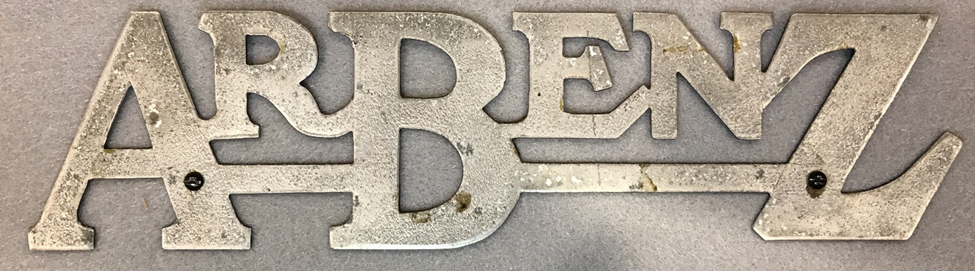
This is an ArBenz radiator script (c1912)   khc
Size: 245mm wide

The ArBenz was named after Fred C. Arbenz and his son Nand James Arbenz, who designed their car. They initially set up the Scioto Car Company to produce the ArBenz but in August 1911 it was announced that the company name would change to the ArBenz Car Company.

The ArBenz was initially a 30/40 hp four-cylinder car offered in four models in the mid-price range until 1914. For 1914, the engine size was reduced to 27 hp but increased to 40 hp again for 1915 and then available in roadster or touring body styles. A much smaller 17 hp Model 25 five passenger touring was the only ArBenz offering from 1916 to the end of production.

In March 1916, the company was taken over by the National United Service Company but ArBenz production did not continue beyond late 1917. By 1918, only a few ArBenz cars were being produced from parts on hand.

Emblem

From the start, Scioto Car Company advertisements spelled the name of their car as the "ArBenZ" to suggest an association with Barney Oldfield and the Blitzen Benz race car, which Barney Oldfield used in 1910 to break land speed records thereby creating great public interest.  

ArBenZ car adv (1911)    catj

ArBenZ cars did not have a radiator emblem but did display the "ArBenZ" name using a plated brass script mounted on the radiator core, as seen in ArBenZ advertisements and original period photos, see examples shown below: 

ArBenZ car ad (1912)
The Dayton Herald

Detail showing "ArBenz" radiator script (1912)

ArBenZ motor car showing radiator script (c1911)    rosscountyhistoricalsociety

ArBenZ motor car showing radiator script (1912)    rosscountyhistoricalsociety


This is the ArBenZ radiator script shown above at the top of this post and again below. Original ArBenZ radiator scripts are very rare.

This is an ArBenZ radiator script (c1912)   khc
Size: 245mm wide


May 22, 2025

LOGAN

Motor Storage & Manufacturing Co. (1904)
Logan Construction Co. (1904-1908)
Chillicothe, Ohio


This is a Logan radiator script (c1907-1908)   khc
Size: 178mm wide 76mm high   MM: Greenduck

The Logan motor car and motor truck were produced by Benjamin A. Gramm from early 1904. The first Logan car was a 10 hp two-cylinder five-passenger touring, which grew to 20 hp in 1905. Four-cylinder models were introduced in 1906. 

The Logan cars were well built and aptly used the slogan " That Car of Quality". They were offered in water-cooled and air-cooled versions until 1907, after when all Logan cars were air-cooled.  

Logan commercial vehicles were also built from 1904 and by 1907 the company was beginning to concentrate on this side of the business. The Logan company was bankrupt by mid-1908. Benjamin Gramm then moved to Bowling Green, Ohio and established the Gramm-Logan Motor Car Company for the production of motor trucks.

Emblems

The first Logan vehicles from 1904 did not carry an emblem but would have displayed the company name on a small maker's nameplate attached to the body or at the rear of the vehicle.

By 1905, some, but not all, Logan models displayed the "Logan" name on a script attached to the body panel at the side of the driver's seat,most likely using a decal, see example shown below:

Logan Model D with body side script (1905)   hac

The photo below of a surviving 1906 Logan Model F appears to show a radiator emblem but this is due to a shadow or discoloration of the radiator top. The side view of the same car confirms that there is no radiator emblem:

Logan Model F (1906)  rosscountyhistoricalsociety

Logan Model F side view 

The following Logan advertisement from 1906 includes an original photo of a similar Logan car again confirming that there was no radiator emblem and no body side script:

Logan advertisement (1906)  rosscountyhistoricalsociety

However, the "Logan-That Car of Quality" slogan is displayed on the brass sill plates and the "Logan" name is cast into the central frame bar under the driver's entrance, see photos shown below:

Logan Model F showing sill plate and central frame bar below (1906)  rosscountyhistoricalsociety

Close up showing "Logan" name cast on frame bar (1906)

There are few original period photos of Logan vehicles and most either show no sign of an emblem or the photo is of very poor quality. 

The following original period photo from 1908 shows a Logan commercial vehicle with no radiator emblem but the "Logan" name is displayed on the body panel at the side of the driver's cab, as shown earlier,  probably using a decal:

Logan truck without rad emblem (1908)    flickr

However, the following poor quality original period photo of a Logan police van from 1907 or 1908 shows a brass "Logan" script mounted on the radiator core, see below:

Logan police van showing radiator script (c1907)     rosscountyhistoricalsociety

The detailed design of this Logan radiator script is not clear from the photo but is similar to the brass Logan script shown above at the top of this post and again below. This Logan radiator script is certainly original, as, unusually, it carries a Greenduck maker's mark. This Logan radiator script is very rare:

This is a Logan radiator script (c1907-1908)   khc
Size: 178mm wide 76mm high   MM: Greenduck

The following is a different and much larger Logan radiator script, which is part of an emblem collection put together in the 1930's and is likely to be original. This Logan radiator script is also very rare.

This is a Logan radiator script (c1907-1908)   sam
Size: 301mm wide


April 11, 2025

REYA

Reya Motor Co. (1917-1918)

Napoleon, Ohio


This is a Reya radiator emblem (1917-1918)   sam
Size: 75mm wide 39mm high    MM: Unknown

The Napoleon Motor Car Company (see Napoleon Truck) had been established in Napoleon, Ohio in early 1916 but moved their passenger car business to Traverse City, Michigan in 1917.  The Reya Motor Company was set up in 1917 to take over the truck building arm of the Napoleon Motor Car Company and was named after the General Manager, Malcolm Hall Ayer ("Ayer" in reverse is "Reya").

The Reya Motor Company business was primarily truck manufacturing but a few Reya passenger cars were also built in 1917. Reya motor trucks were apparently produced into 1918. However, there are no recorded details of Reya trucks or passenger cars and production numbers were likely to have been very small.

Emblem

The following original period photo of a Reya truck shows a rectangular radiator emblem:

Reya Model A truck showing radiator emblem (1917) wheelswaterengines

This is the pale blue, black and white enamel Reya radiator emblem shown above at the top of this post. This Reya emblem is believed to have been displayed also on Reya passenger cars and is extremely rare.